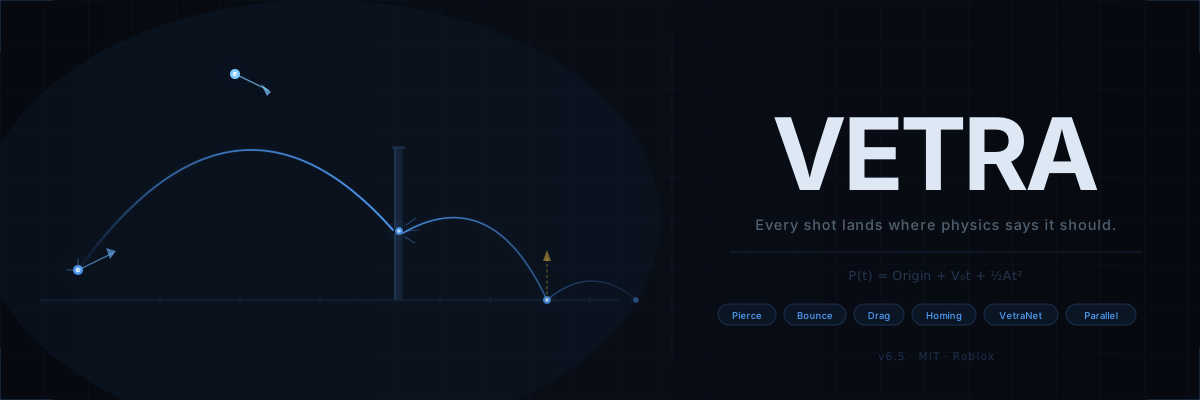
Every Shot Lands Where Physics Says It Should
Vetra is a projectile simulation module for Roblox. It uses exact kinematic trajectories, no per-frame drift, no frame-rate dependency, no client/server divergence, and builds a full physics and networking stack on top of that foundation: pierce, bounce, hitscan, homing, drag (linear, quadratic, G-series empirical models), Magnus effect, Coriolis deflection, gyroscopic drift, 6DOF aerodynamics, tumble, fragmentation, high-fidelity sub-segment raycasting, LOD, parallel physics via Roblox Actors, and VetraNet, a full authoritative network layer.
One Folder. One Require.
Drop the Vetra folder into ReplicatedStorage and require it from your weapon scripts.
The Solver Listens. You React.
local Vetra         = require(ReplicatedStorage.Vetra)
local BulletContext = Vetra.BulletContext

-- Create the solver once (connects the frame loop)
local Solver  = Vetra.new()
local Signals = Solver:GetSignals()

-- Connect to signals once at initialisation
Signals.OnFire:Connect(function(context, behavior)
    -- Fires immediately after Fire() registers the cast, before the first step.
    -- OnFire uses FireSync — all handlers run synchronously on the calling thread
    -- even if connected via ConnectAsync. This guarantees any state you write
    -- here is visible before the first simulation step runs.
    print("Bullet fired:", context)
end)

Signals.OnHit:Connect(function(context, result, velocity)
    if result then
        print("Hit", result.Instance.Name, "at", result.Position)
    else
        -- result is nil on distance/speed expiry
        print("Bullet expired")
    end
end)

Signals.OnBounce:Connect(function(context, result, velocity, bounceCount)
    print("Bounce #" .. bounceCount)
end)
Define the Physics. Pull the Trigger.
-- Build a behavior once per weapon type, not per shot
local Behavior = Vetra.BehaviorBuilder.new()
    :Physics()
        :MaxDistance(500)
        :MinSpeed(5)
    :Done()
    :Bounce()
        :Max(3)
        :Restitution(0.7)
        :Filter(function(context, result, vel)
            return true -- bounce off everything
        end)
    :Done()
    :Build()

-- Fire
local context = BulletContext.new({
    Origin            = muzzlePosition,
    Direction         = direction,
    Speed             = 200,
    FireTravelEvents  = true, -- optional: set false to suppress OnTravel/OnTravelBatch for this bullet
})

Solver:Fire(context, Behavior)
Don't Start From Scratch
BehaviorBuilder ships with three preset constructors as a starting point:
-- Sniper: 1500 studs, pierce-capable, high fidelity
local SniperBehavior = Vetra.BehaviorBuilder.Sniper():Build()

-- Grenade: low speed, bouncy, corner-trap aware
local GrenadeBehavior = Vetra.BehaviorBuilder.Grenade():Build()

-- Pistol: 300 studs, single pierce
local PistolBehavior = Vetra.BehaviorBuilder.Pistol():Build()
Chain additional overrides on any preset before calling :Build():
local Behavior = Vetra.BehaviorBuilder.Sniper()
    :Physics()
        :MaxDistance(2000)
    :Done()
    :Build()
Carry State With Every Bullet
Use UserData to attach weapon-specific data that travels with the bullet and is available in every
signal handler. You can seed it directly in the config or set fields after construction:
-- Seed at construction
local context = BulletContext.new({
    Origin    = muzzlePosition,
    Direction = direction,
    Speed     = 200,
    UserData  = { Damage = 75, ShooterId = Players.LocalPlayer.UserId },
})

-- Or set after
context.UserData.Damage    = 75
context.UserData.ShooterId = Players.LocalPlayer.UserId

Signals.OnHit:Connect(function(context, result, velocity)
    print("Damage:",   context.UserData.Damage)
    print("Fired by:", context.UserData.ShooterId)
end)
BulletContext.new() config fields:
| Field | Type | Description |
|---|---|---|
Origin | Vector3 | Muzzle position (required) |
Direction | Vector3 | Fire direction (required) |
Speed | number | Initial speed in studs/s (required) |
UserData | any? | Pre-populate the UserData table at construction |
RaycastParams | RaycastParams? | Per-bullet raycast filter — highest priority over Behavior params |
FireTravelEvents | boolean? | Opt in to OnTravel/OnTravelBatch for parallel FF casts (default false) |
BulletContext fields available in every signal handler:
| Field | Type | Description |
|---|---|---|
Origin | Vector3 | Muzzle position at the time of Fire() |
Direction | Vector3 | Initial direction unit vector |
Speed | number | Initial speed in studs/s |
Position | Vector3? | Current position (updated each step) |
Velocity | Vector3 | Current velocity vector |
Alive | boolean | False once the bullet has terminated |
Length | number | Total path length travelled so far |
SimulationTime | number | Time elapsed since Fire() |
UserData | any | Free-form table for weapon-specific state |
RaycastParams | RaycastParams? | Per-bullet raycast params (optional) |
BulletContext methods:
| Method | Returns | Description |
|---|---|---|
:IsAlive() | boolean | Whether the bullet is still simulating |
:GetLifetime() | number | Seconds since Fire() |
:GetDistanceTraveled() | number | Total path length in studs |
:GetSnapshot() | BulletSnapshot | Immutable point-in-time copy of bullet state |
:GetCast() | Cast? | Internal Cast object — available from OnFire onwards |
:Terminate() | () | Manually terminate the bullet |
Your Raycast. Your Rules.
By default Vetra uses workspace:Raycast for every intersection test. CastFunction replaces that
with any function that matches the same signature, workspace:Spherecast, workspace:Blockcast,
or a completely custom wrapper:
-- Spherecast, treats the bullet as a sphere with a radius
Solver:Fire(context, {
    MaxDistance  = 500,
    CastFunction = function(origin, direction, params)
        return workspace:Spherecast(origin, 0.5, direction, params)
    end,
})
-- Blockcast, useful for shotgun pellets or wide projectiles
Solver:Fire(context, {
    CastFunction = function(origin, direction, params)
        local BoxZ    = 0.01
        local dirUnit = direction.Unit
        local center  = origin - dirUnit * (BoxZ / 2)
        local size    = Vector3.new(0.2, 0.2, BoxZ)
        local cframe  = CFrame.lookAt(center, center + direction)
        return workspace:Blockcast(cframe, size, direction, params)
    end,
})
This applies to Blockcast, Spherecast, and Raycast alike. If the shape or ray origin starts
inside or touching a surface, that surface is invisible to the cast. For Blockcast this is easy to
trigger accidentally: centering the box at origin with a non-zero Z size means the front face
starts Z/2 ahead of the bullet. Any wall within that gap is already overlapping the starting box
and will be silently skipped. The example above avoids this by offsetting the center backward so
the front face is flush with origin.
-- Custom wrapper, ignore water terrain, apply a tag filter
Solver:Fire(context, {
    CastFunction = function(origin, direction, params)
        local result = workspace:Raycast(origin, direction, params)
        if result and result.Instance:HasTag("Ignored") then
            return nil
        end
        return result
    end,
})
direction is the raw displacement vector for that frame, not a unit vector. Its magnitude is the
cast distance. Do not normalise it before passing to the underlying cast call or you will cast the
wrong distance.
CastFunction is ignored by Vetra.newParallel(), functions cannot cross Actor boundaries.
Use Vetra.new() if you need a custom cast function.
20,000 Bullets. 10ms.
For high bullet-count scenarios, use the parallel solver to distribute physics computation across Roblox Actors:
local Solver = Vetra.newParallel({
    ShardCount = 6,
})

-- API is identical to Vetra.new()
Solver:Fire(context, Behavior)
Parallel overhead breaks even around 50–100 active bullets. Below that threshold Vetra.new() is
typically faster. Above ~200 bullets with physics features enabled, the parallel version scales
significantly better. If Actor construction fails internally, newParallel automatically falls back
to a serial solver and logs an error, your call site receives a working solver either way.
CastFunction overrides in VetraBehavior are ignored by the parallel solver, functions
cannot cross Actor boundaries. Use Vetra.new() if you need a custom cast function.
Fire-and-forget vs sync casts
The parallel solver automatically classifies each bullet as either sync or fire-and-forget (FF):
- Sync — stepped by the Coordinator each
Heartbeat. Required when the bullet has callbacks (CanBounce,CanPierce,CanHome,HomingPositionProvider,TrajectoryPositionProvider) or whenFireTravelEvents = trueon theBulletContext. - FF — stepped autonomously via
PreSimulation:ConnectParallelwith no main-thread involvement per frame. Only terminal events (Hit / DistanceEnd / SpeedEnd) are delivered to the Coordinator. Travel signals and cosmetic part updates are skipped.
FF casts have near-zero per-frame allocation overhead — SharedTable slots are reused in-place after the first few frames. Use them for high-volume projectiles that don't need per-frame callbacks or travel events.
-- FF cast: no callbacks, travel events suppressed — fully autonomous in parallel
local context = BulletContext.new({
    Origin           = muzzlePosition,
    Direction        = direction,
    Speed            = 200,
    FireTravelEvents = false, -- default; explicit here for clarity
})
Solver:Fire(context, Behavior)

-- Sync cast: has a homing provider, so main-thread sync is required
local homingContext = BulletContext.new({
    Origin           = muzzlePosition,
    Direction        = direction,
    Speed            = 200,
    FireTravelEvents = true, -- opt into OnTravel even without callbacks
})
Solver:Fire(homingContext, HomingBehavior)
The Coordinator also skips StepShard dispatch entirely for shards that contain only FF casts, and skips the homing/provider update pass when no sync casts are active.
Stop Trusting the Client
Wrap a solver with WithValidator to enable authoritative hit checks on the server:
-- Server only; safe no-op on the client so setup code can be shared
local Solver = Vetra.WithValidator(Vetra.new(), {
    MaxOriginTolerance = 20,
    PositionTolerance  = 15,
    VelocityTolerance  = 80,
    TimeTolerance      = 0.15,
})
Bullets Don't Travel in a Vacuum
Set DragCoefficient > 0 to enable drag. All fields are available via BehaviorBuilder:Drag() or passed directly on the behavior table:
local Enums = Vetra.Enums

Solver:Fire(context, {
    MaxDistance         = 800,
    MinSpeed            = 5,
    DragCoefficient     = 0.003,
    DragModel           = Enums.DragModel.G7,  -- long boat-tail, modern sniper standard
    DragSegmentInterval = 0.05,                -- seconds between recalculation steps
})
Available drag models (accessed via Vetra.Enums.DragModel):
| Key | Description |
|---|---|
Enums.DragModel.Linear | Deceleration ∝ speed |
Enums.DragModel.Quadratic | Deceleration ∝ speed², default, most accurate subsonic |
Enums.DragModel.Exponential | Deceleration ∝ eˢᵖᵉᵉᵈ, exotic high-drag shapes |
Enums.DragModel.G1 | Flat-base spitzer; general purpose standard |
Enums.DragModel.G5 | Boat-tail spitzer; mid-range rifles |
Enums.DragModel.G6 | Semi-spitzer flat-base; shotgun slugs |
Enums.DragModel.G7 | Long boat-tail; modern long-range / sniper standard |
Enums.DragModel.G8 | Flat-base semi-spitzer; hollow points / pistols |
Enums.DragModel.GL | Lead round ball; cannons / muskets / buckshot |
Enums.DragModel.G2, G3, G4 | Aberdeen / atypical projectile shapes |
Enums.DragModel.Custom | Requires CustomMachTable = { {mach, cd}, ... } on the behavior |
Passing Vetra.Enums.DragModel.G7 instead of the integer 10 or the string "G7" means a typo is
a nil-index warning at the call site rather than a silent wrong value or a validation error at
:Build() time. If an enum value is ever renamed, every reference site produces an error rather than
silently passing the wrong value. The same applies to Vetra.Enums.TerminateReason in
OnPreTermination handlers.
Supersonic and Subsonic Profiles
Override drag, restitution, and normal perturbation per speed regime. The solver tracks whether the bullet is supersonic (above 343 studs/s) and blends in the matching profile:
local Enums = Vetra.Enums

Solver:Fire(context, {
    DragCoefficient   = 0.002,
    DragModel         = Enums.DragModel.G7,
    SupersonicProfile = {
        DragCoefficient = 0.0015,
    },
    SubsonicProfile = {
        DragCoefficient    = 0.004,
        Restitution        = 0.5,
        NormalPerturbation = 0.05,
    },
    SpeedThresholds = { 343 }, -- fire OnSpeedThresholdCrossed when crossing this
})

Signals.OnSpeedThresholdCrossed:Connect(function(context, threshold, velocity)
    if threshold == 343 then print("Went subsonic") end
end)
Spin Makes It Curve
A spinning projectile experiences lateral force perpendicular to both its spin axis and velocity —
the curveball effect. Evaluated together with drag every DragSegmentInterval seconds:
Solver:Fire(context, {
    SpinVector        = Vector3.new(0, 0, 1) * 300, -- right-hand twist, 300 rad/s
    MagnusCoefficient = 0.0001,
    SpinDecayRate     = 0.05,  -- 5% spin loss per second
})
MagnusCoefficient is highly sensitive. Start at 0.00005–0.0001 and increase
incrementally, at high speeds even 0.001 produces dramatic deviation.
Gyroscopic Drift
Simulate yaw from spin-induced gyroscopic precession. Applied as a lateral acceleration each drag recalculation step:
Solver:Fire(context, {
    GyroDriftRate = 0.5,                      -- acceleration in studs/s²
    GyroDriftAxis = Vector3.new(0, 1, 0),     -- nil = world UP (right-hand rifling)
})
When Stability Breaks
A bullet enters tumble mode when its speed drops below a threshold, multiplying drag and adding chaotic lateral forces. It can optionally recover:
Solver:Fire(context, {
    TumbleSpeedThreshold  = 100,   -- begin tumbling below 100 studs/s
    TumbleDragMultiplier  = 4.0,   -- drag x 4 while tumbling
    TumbleLateralStrength = 5,     -- chaotic lateral accel in studs/s²
    TumbleOnPierce        = true,  -- begin tumbling immediately on first pierce
    TumbleRecoverySpeed   = nil,   -- nil = permanent; set a number to auto-recover
})

Signals.OnTumbleBegin:Connect(function(context, velocity)
    print("Tumbling at", velocity.Magnitude, "studs/s")
end)
Signals.OnTumbleEnd:Connect(function(context, velocity)
    print("Recovered at", velocity.Magnitude, "studs/s")
end)
One Round. Five Threats.
Spawn child bullets in a cone on pierce. Each fragment is a fully live cast inheriting the parent's behavior:
Solver:Fire(context, {
    CanPierceFunction = function(ctx, result, vel) return true end,
    MaxPierceCount    = 1,
    FragmentOnPierce  = true,
    FragmentCount     = 5,    -- number of fragments
    FragmentDeviation = 20,   -- cone half-angle in degrees
})

Signals.OnBranchSpawned:Connect(function(parentContext, childContext)
    childContext.UserData.IsFragment = true
    childContext.UserData.Damage = parentContext.UserData.Damage * 0.3
end)
It Will Find Them
Steer the bullet toward a dynamic target position each frame. All fields are available via BehaviorBuilder:Homing() or passed directly on the behavior table:
local target = workspace.TargetPart

Solver:Fire(context, {
    HomingPositionProvider  = function(pos, vel)
        return target.Position  -- return nil to disengage mid-flight
    end,
    HomingStrength          = 90,  -- steering force in degrees/second
    HomingMaxDuration       = 5,   -- disengage automatically after 5 seconds
    HomingAcquisitionRadius = 0,   -- 0 = engage immediately; set a stud distance to delay
    CanHomeFunction = function(ctx, pos, vel)
        return not ctx.UserData.HomingDisabled
    end,
})

Signals.OnHomingDisengaged:Connect(function(context, reason)
    print("Homing ended:", reason)
end)
Physics? Optional.
Replace Vetra's kinematic physics entirely with a custom position function. Useful for scripted paths, spline-driven projectiles, or cinematic abilities:
Solver:Fire(context, {
    TrajectoryPositionProvider = function(elapsed)
        -- elapsed = seconds since this cast was fired
        -- Return nil to end the custom path and terminate the cast
        return CFrame.new(origin) * CFrame.Angles(0, elapsed, 0) * CFrame.new(0, 0, -elapsed * speed)
    end,
})
Zero Physics. Instant Resolution.
Hitscan resolves the entire bullet path, pierce, bounce, all signals, synchronously inside Fire().
No per-frame physics stepping, no gravity, no drag, no Magnus: the bullet travels in straight lines
between bounces and terminates before Fire() returns.
Use it for weapons where physics don't add anything: railguns, laser shots, instant-hit scanners, or any design where the bullet arriving instantly is the point.
local Behavior = Vetra.BehaviorBuilder.new()
    :Hitscan(true)
    :Physics()
        :MaxDistance(1000)
    :Done()
    :Build()

Solver:Fire(context, Behavior)
-- By the time Fire() returns, OnHit has already fired.
Pierce and bounce still apply, the full hit chain runs, just synchronously. All signals (OnHit,
OnBounce, OnPierce, OnTerminated) fire in the normal order before Fire() returns.
DragCoefficient, SpinVector, MagnusCoefficient, gravity, homing, none of these apply to
hitscan casts. If you need a fast projectile with physics, increase speed and reduce MaxDistance
instead of enabling hitscan.
Wind
Solver:SetWind(Vector3.new(10, 0, 0))  -- 10 studs/s eastward

-- Per-bullet sensitivity via behavior table:
Solver:Fire(context, { WindResponse = 0.5 }) -- 50% of wind applied
Solver:Fire(context, { WindResponse = 0.0 }) -- ignores wind entirely
Even the Earth Gets a Vote
Coriolis is a solver-level environment setting, not a per-bullet behavior field. Call
SetCoriolisConfig once per map/zone, all bullets fired through that solver are affected equally:
-- Arctic map, strong northern deflection
Solver:SetCoriolisConfig(75, 1200)

-- Equatorial map, horizontal east/west drift only
Solver:SetCoriolisConfig(0, 800)

-- Disable entirely (default)
Solver:SetCoriolisConfig(45, 0)
| Scale | Effect |
|---|---|
0 | Disabled, zero overhead (default) |
500 | Subtle; detectable only at long range |
1000 | Clearly perceptible at ~300 studs |
3000 | Strong, map-defining mechanic |
LOD
Tell the solver where to focus simulation fidelity:
-- Update every frame with camera position (clients)
Solver:SetLODOrigin(workspace.CurrentCamera.CFrame.Position)

-- Update each frame with entity positions (server)
Solver:SetInterestPoints({ player1.Character.HumanoidRootPart.Position, ... })
Intercept. Override. Continue.
OnPreBounce, OnMidBounce, OnPrePierce, and OnMidPierce receive a MutateData
callback as their last argument, allowing synchronous override of physics values mid-calculation:
-- Force flat-floor reflection by overriding the surface normal
Signals.OnPreBounce:Connect(function(context, result, velocity, mutate)
    mutate(Vector3.new(0, 1, 0), nil)  -- (newNormal, newIncomingVelocity)
end)

-- Force 90% restitution after the reflect math runs
Signals.OnMidBounce:Connect(function(context, result, inVel, mutate)
    mutate(nil, 0.9, nil)  -- (newPostVelocity, newRestitution, newNormalPerturbation)
end)

-- Cap pierce count for this bullet on the fly
Signals.OnPrePierce:Connect(function(context, result, velocity, mutate)
    mutate(nil, 1)  -- (newEntryVelocity, maxPierceOverride)
end)

-- Remove speed loss on exit
Signals.OnMidPierce:Connect(function(context, result, velocity, mutate)
    mutate(1.0, nil)  -- (newSpeedRetention, newExitVelocity)
end)
MutateData is only active during the synchronous handler. Calling it after the handler returns
logs a warning and has no effect, do not yield inside hook signal handlers.
The Bullet That Refused to Die
OnPreTermination lets you cancel a bullet's death. Each termination reason is tracked separately —
after 3 consecutive cancels for the same reason, the bullet is force-terminated regardless:
local Enums = Vetra.Enums

Signals.OnPreTermination:Connect(function(context, reason, mutate)
    if reason == Enums.TerminateReason.Hit and context.UserData.HasShield then
        mutate(true, nil)  -- (cancelled: boolean, newReason: string?)
    end
end)
The Network Layer You Didn't Have to Write
VetraNet is Vetra's built-in network middleware. It handles fire-request serialization, server-side
authority, and client-side cosmetic replication, all over a single RemoteEvent.
Shared setup (ModuleScript required by both sides):
local Registry = Vetra.VetraNet.BehaviorRegistry.new()
Registry:Register("Rifle",   RifleBehavior)
Registry:Register("Shotgun", ShotgunBehavior)
return Registry
Both server and client must register behaviors in the same order with the same names. If
they diverge, every fire request will be rejected as RejectedUnknownBehavior. Enforce this by
requiring the same shared ModuleScript on both sides.
Server:
local Net = Vetra.VetraNet.new(ServerSolver, SharedRegistry, {
    MaxOriginTolerance  = 20,
    TokensPerSecond     = 10,
    BurstLimit          = 20,
    ReplicateState      = true,
})

Net.OnValidatedHit:Connect(function(owner, context, result, velocity, impactForce)
    -- apply damage, update leaderboard, etc.
end)

Net.OnFireRejected:Connect(function(player, reason)
    warn(player.Name .. " fire rejected: " .. reason)
end)
Client:
local Net = Vetra.VetraNet.new(ClientSolver, SharedRegistry)

Net:Fire(muzzlePosition, direction, speed, "Rifle")
See Exactly What the Bullet Saw
local Behavior = Vetra.BehaviorBuilder.new()
    :Debug()
        :Visualize(true)
    :Done()
    :Build()
Draws cast segments, hit normals, bounce vectors, and corner-trap markers in-world. Zero runtime cost when disabled, no draw calls or raycasts are added.